

Tide And Terrain
Tide and Terrain is a multi-sensory art experience that celebrates the fragile beauty and quiet resilience of Long Island’s coastal and inland habitats. Through vivid photography, sculpture, and mixed-media installations, pioneering aquarist and marine biologist Joe Yaiullo transforms decades of ecological expertise—and a lifetime immersed in the island’s rhythms—into evocative visual storytelling.
Grace of Flight
Print on Aluminum

“With photography and sculpture, I capture moments that often go unnoticed—light catching a bird’s wing just right, wind skimming across the water, the shift between night and morning. These moments speak to nature’s strength, movement, and constant change.
— Joe Yaiullo
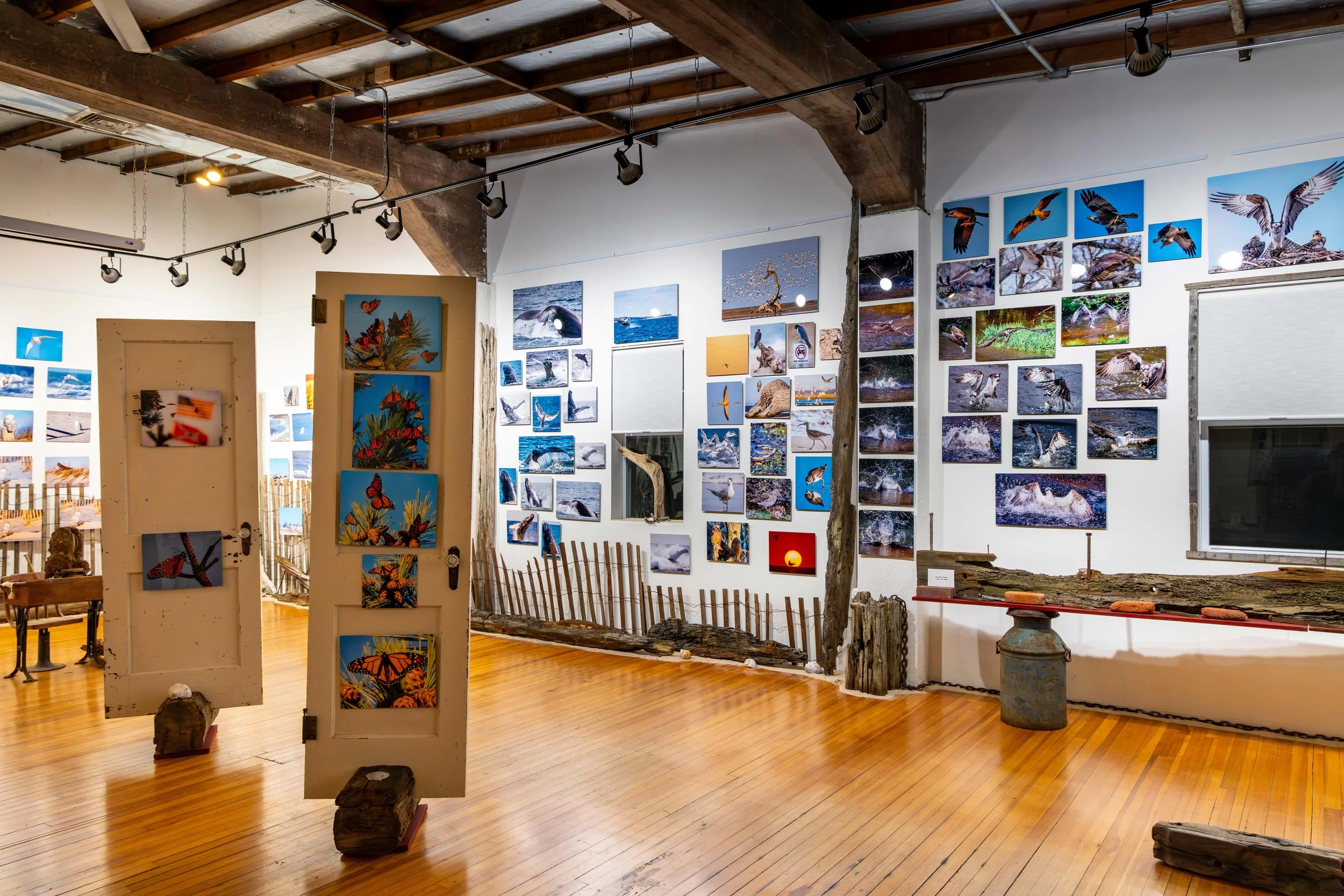
Tide & Terrain | The Opening
November 1, 2025
-
This evocative sculpture is built from materials shaped by the Atlantic over decades—each fragment carrying its own story of origin, erosion, and rebirth. The central beam, weathered and worn, may have once supported a large sea-faring vessel. Now it serves as the structural core of the piece and a spine for reflection. On one side, fresh brick and sharp metal suggest recent construction, human ambition, and the illusion of permanence. On the other, rusted fragments, softened brick, and rusted metal speak to time’s slow reclamation, sculpted by salt, wind, and waves.
These materials were gathered from Long Island’s shifting shorelines—salvaged from tidal debris, salvage stores, and eroded structures. Transformed in Joe’s home studio, they are reimagined not as waste, but as witnesses—objects that once served a purpose, and will again, in a new form. The installation becomes a meditation on impermanence and continuity: a reflection of how everything we build is part of nature’s cycle, destined to be reshaped, reused, and reabsorbed. It’s a tactile narrative where decay and renewal are constant—and a recognition that even our built environments are not separate from nature, but part of its evolving landscape.
-
The transition from night into day mirrors the deeper rhythms of Tide and Terrain: migration and return, loss and renewal, stillness and motion. The tidal zone—where land meets sea—is far more than a visual boundary. It’s a dynamic place of transition that is vital to coastal environments. As tides rise and fall, this place becomes a conveyor belt of organic material: seaweed, shells, driftwood, and detritus that nourish dune ecosystems and provide food for countless species.
The tidal zone supports a rich web of life. In essence, it is the stitching that binds ocean and land, resilience and renewal.
Symbolically, it reminds us that boundaries in nature are rarely fixed. They shift, adapt, and evolve—just like the species that depend on them. To walk the wrack line is to see what’s left behind, witness the dynamics of tide and terrain, and to understand that life thrives not in separation, but in connection.
-
The terrain—where forest meets field, where root meets rock—is far more than a static landscape. It is a living mosaic of transition, shaped by wind, weather, and time. As seasons shift and soil breathes, this place becomes a reservoir of organic exchange: fallen leaves, decaying wood, and mineral-rich earth that nourish inland ecosystems and sustain countless species.
The terrain supports a layered web of life. In essence, it is the stitching that binds upland and lowland, shelter and sustenance, decay and renewal.
Symbolically, it reminds us that boundaries in nature are rarely rigid. They blur, bend, and transform—just like the species that inhabit them. Just like us. To walk the forest floor or trace the edge of a meadow is to witness the slow pulse of terrain and time, and to understand that life flourishes not in isolation, but through interwoven relationships.

-
Tide and terrain meet at nature’s threshold—those shifting edges where land and sea, forest and field, blur into one another. These are places of motion and migration, where species cross between worlds and ecosystems exchange breath. From the shoreline to the leaf-littered floor of inland woods, life pulses through transition.
The tidal zone is a living seam, stitched by the rise and fall of water. It carries seaweed, shells, and driftwood to nourish dunes and feed shorebirds, crabs, and scavengers. It is a place of return and renewal, where boundaries are drawn and redrawn with each tide. And it is here, too, that ephemeral visitors appear—unexpected and fleeting. A flamingo, blown off course, stands radiant in unfamiliar waters. Wind-sculpted sand art unfurls across the beach, only to be swept away by the next gust or wave. These moments are rare, but they are reminders of nature’s improvisation.
The terrain, too, is a mosaic of movement—where osprey soar over marshes, turtles burrow into soft earth, and butterflies drift between meadow and forest. It is shaped by wind and time, a reservoir of decay and growth, shelter and sustenance. Here, young animals take their first steps, flights, and dives—learning the rhythms of tide and terrain, testing boundaries, and finding their way in a world of shifting edges.
Together, tide and terrain form a continuum. They remind us that nature thrives not in separation, but in connection. These threshold places are not margins—they are meeting grounds, where the story of life is written in motion, and where even the briefest arrivals leave lasting impressions.